TL;DR: Traditional TMS relies on dispatcher knowledge and organization, while a TMS integrated with AI gives suggestions based on historical data. AI vs traditional TMS comes down to where you want to spend time in your operations. Relying solely on traditional systems gives you full control with room for gaps and errors. AI systems require giving up some control in exchange for intelligent automation and data-driven solutions.
You have two questions to answer when deciding between AI vs traditional transportation management systems (TMS):
- Who’s making the call on which loads get priority? Dispatcher experience or machine learning through historical data?
- Are routes getting built manually at 5 a.m. or automatically as conditions change?
Traditional TMS puts every decision on your dispatcher. They tag loads, build folder structures, and remember which customers pay fast and which facilities cause delays. But if they’re out sick after working multiple 12-hour shifts in a row, that knowledge disappears.
Your data and completed deliveries show AI-powered TMS how to scale your operations.
AI vs Traditional TMS: Which Fits Your Operation?
| Your Situation | Go With | Why |
|---|---|---|
| Dispatchers keep quitting, knowledge walks out the door | AI-powered | AI learns patterns automatically, while a new hire gets recommendations day one |
| Same dispatch team,5+ years, stable customer base | Traditional | An experienced team knows the lanes. System tracks what they tell it |
| Customer mix changes monthly, always adding new lanes | AI-powered | Adapts without constant folder restructuring |
| Growing 20 to 50+ trucks in 18 months | AI-powered | Scales without adding dispatcher headcount |
| Specialized freight, low volume (under 200 loads/month) | Traditional | AI needs transaction volume to build patterns |
| Data’s a mess with half-completed tags and inconsistent naming | Traditional (fix data first) | AI learns from clean data. |
Traditional TMS depends on dispatcher organization
Effective until your reliable dispatcher is MIA.
Traditional TMS works when your dispatchers aren’t using the chicken scratch notepad method: notes on multiple pages, nothing organized.
An effective dispatcher should be tagging loads by customer, lane, equipment type, and delivery window. Dallas, TX, customers in one folder, reefer loads in another, hazmat separate. If they can find the information, everything works as needed.
But if that one dispatcher is out and no one knows his system, the whole operation falls apart, and downtime adds up. Which folder are you looking for? Is this even the right customer?
Consistency has to be a priority above all else.
One dispatcher tags Chicago runs as “IL-Chicago.” Another uses “CHI.” A third uses “Midwest.” Six months later, you’re pulling profitability reports on Chicago, and the data is getting mixed up because there wasn’t a consistent system. If the team has a coded language, that can work up until a point. But if a new employee comes on, there’s no universal language that’s easy to understand.
That coded knowledge never makes it into the system. Your experienced dispatcher knows Miller Logistics pays on time, and their loads set up good backhauls. Knows avoiding I-40 eastbound on Friday afternoons saves two hours. When they’re out sick, you lose revenue on a load because nobody remembered Miller’s facility closes at 3 PM on Thursdays, and your driver sat in detention for four hours.
How AI-integrated TMS uses your delivery history
Data needs to be clean and relies on your tracking.
Your data and completed delivery history build a model of what works.
Loads heading to Atlanta on Thursday afternoons run late because I-285 traffic backs up around shift changes at distribution centers. AI flags Thursday Atlanta runs as a higher risk, suggesting earlier departure times or alternate routes through I-85, if your data is clean and organized.
Without correct organization and structure, the AI will be pulling from mismatched patterns.
This is a prerequisite before deciding to integrate AI into your system.
Once AI is operating, your team moves faster.
A driver gets detained at a customer facility three times in two months. The system correlates that pattern with other loads going to the same facility and adjusts scheduling expectations. Next time that customer books a load, AI pads the delivery window automatically and alerts your dispatcher that this location has a history of delays.
Every load also gets reporting to pull at any time: rate per mile, deadhead distance to pickup, estimated fuel costs, and whether it positions your truck for a profitable backhaul.
Two Ways to Catch Delay Patterns
What happens when there’s a pattern in delays that no one is seeing?
If a driver calls in two hours late for a delivery in Charlotte, the dispatcher marks it as traffic and moves on. Three weeks later, same city, same excuse. A month after that, it happens again. A traditional TMS logs each delay separately, but nobody is connecting them.
1. Solve the delay through manual effort.
Finding the pattern through a traditional TMS means exporting delivery data to Excel, filtering by city, checking timestamps, and remembering which delays were weather, traffic, or customer issues.
2. AI will track the data and flag the delay.
An AI-driven TMS groups similar incidents automatically. Three Charlotte deliveries run late during afternoon windows, so the platform flags the pattern: southbound I-77 hits construction delays between 2 PM and 5 PM. Then there’s a suggestion for morning arrivals or routing through I-485.
Delays always cluster around specific customers, routes, and timeframes, but the AI will catch these when a dispatcher who’s too overwhelmed with load planning and assigning routes can’t see the patterns.
AI vs Traditional TMS: Seeing What You Completed vs. What You Missed
What traditional TMS will show you.
When your traditional TMS shows your fleet completed 94% of accepted loads last month, it’s still not showing the 30 Dallas loads you rejected because no trucks were positioned there. Or the customer who stopped calling because you couldn’t cover their Thursday afternoon pickups.
AI-integrated TMS gives you a whole picture of your operations.
AI analyzes loads you declined and clusters them by lane, timing, and equipment type. It shows you’re turning away monthly revenue in reefer loads to the Southeast because you only run two refrigerated trucks, and they’re always booked.
You see the accepted load percentage, but now you’re also seeing the gap of where operations can improve next month.
If your fleet sees Midwest volume drops every January while Northeast demand spikes, the AI suggests redeploying trucks to where the work is instead of running half-empty in slow markets.
When Dispatcher Control Beats Automation
Bringing AI into your systems isn’t straightforward. Your mechanics won’t like getting maintenance requests led by automated suggestions. And your drivers will try to find flaws with monitoring miles and safety automation.
Dispatchers read customer relationships where AI doesn’t.
For ranking loads, AI measures by straight profitability. Dispatchers know when to ignore those rankings because the system can’t calculate what a customer relationship is worth.
Your top customer calls with a rush load at $1.75 per mile to deliver on Wednesday morning. AI flags it as low priority, but your dispatcher takes it anyway. This customer books 40 loads monthly at $2.60 per mile, and the one time you said no to a favor, they stopped calling for six weeks. This costs you $18,000 in lost revenue.
Years of experience are worth their weight.
Veteran dispatchers have seen the challenging customers who force empty miles and tight schedules. They know things AI can’t: that a customer ships standard pallets, but their dock only fits trucks with a 180-inch wheelbase or shorter.
The dispatcher brings experience. AI uses historical data to surface optimization opportunities. The dispatcher evaluates the suggestions against driver schedules, customer history, and constraints the algorithm doesn’t see.
How Cortex AI Works Inside PCS TMS
Your dispatcher is juggling 40 trucks, fielding customer calls, and trying to remember which driver fits which load. Patterns get missed. Backhauls slip by. Knowledge stays in their head instead of the system.
That’s the problem Cortex AI solves.
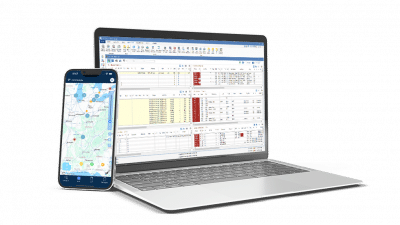
Cortex is the AI engine built directly into PCS TMS. It watches your fleet’s delivery history, learns what works, and surfaces recommendations your dispatcher would make if they had time to analyze every data point.
It flags delay patterns before they cost you money. Identifies backhaul opportunities that would otherwise get missed. Recommends the best driver for every load based on proximity, available hours, and past performance on similar runs.
Your dispatcher still makes the final call. Cortex just makes sure they’re seeing the full picture instead of working from memory and gut feel.
The difference when you scale is that Cortex learns from your operation automatically. When your experienced dispatcher is out, the recommendations are still there. When you grow from 30 trucks to 80, you’re not adding headcount just to keep up with load planning.
The same interface from mid-size fleets to enterprise
Automation never fully takes control of the entire operation. Your team’s decisions are based on their knowledge and are the final say. Cortex AI might give suggestions and show you where a route can be faster or where empty miles can be reduced, but your team stays in control of strategy.
- At 50 trucks, you’re using Cortex for load matching, delay pattern detection, and backhaul optimization.
- At 150 trucks, you’re adding multi-terminal coordination and predictive maintenance alerts.
- At 500 trucks, you’re running regional analytics, capacity forecasting, and cross-terminal visibility.
Same login. Same workflow. Same team that already knows the system.
You’re not ripping out your TMS every time you outgrow it. You’re turning on capabilities inside a platform that already knows your lanes, your customers, and your drivers.
Smaller fleets can start here too, but Cortex is built for operations that are scaling. If you’re at 30 trucks and growing, you’re building on a system that won’t need replacing at 100.
Cortex scales with you, but your dispatchers stay in control. AI surfaces the opportunities. Your team makes the call.
Interested in seeing Cortex AI’s insights for your operation?
Request a free demo to test out an integrated strategy to help scale your operations.
FAQ
No. Cortex AI is built into PCS TMS, not bolted on as a separate product. It’s native to the platform.
Depends on your data quality. AI learns from historical data, so specialized operations with limited route diversity or low load volumes won’t generate enough data for useful pattern recognition. If you’re running 150 loads a month, AI is overkill. You’re paying for features your data can’t feed. Hazmat, oversized, and niche freight carriers often see better results with traditional TMS that relies on dispatcher expertise rather than algorithmic learning that needs high transaction volumes.