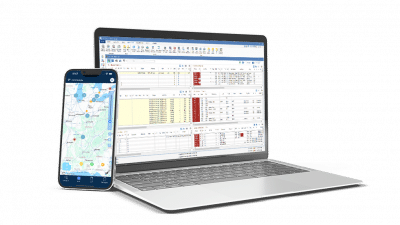
An AI transportation management system (TMS) helps fleets and brokers run tighter operations. By embedding intelligence into the workflow, teams move from chasing updates to working from live data and predictive decision-making. Instead of chasing updates or relying on gut feel, dispatchers, planners, and accountants all work from the same core system.
In this post, we’ll break down the core ways AI TMS delivers value and then explain what separates true AI systems from programs that appear to offer value.
What Is AI TMS and How Does It Work?
Not every system marketed as “AI-powered” actually delivers. Many legacy TMS vendors bolt on automation scripts or dashboards and label them AI. A true AI TMS is different: intelligence is built into the core platform, learning from every shipment and adapting as conditions change.
Here are a few key markers of a true AI TMS:
- Native AI engine: Built and embedded into the platform, not added as a separate tool.
- Real-time learning: Models adjust instantly to traffic, demand, or carrier performance based on live data.
- Integrated data: Pulls inputs from telematics, Electronic Logging Devices (ELDs), accounting, and external carriers.
- Actionable recommendations: Surfaces the next best move instead of raw reports with solution-based ROI.
When AI is woven into the TMS itself, you’re working with a system that helps your operation continuously improve with every shipment. The AI TMS should operate fully and completely across your entire fleet and keep trucks rolling.
Key AI TMS Enhancements for Fleets and Brokers
AI TMS uses live data and predictive models to automate decisions that once depended on manual effort and experience. When intelligence is embedded across planning, execution, and visibility, transportation teams gain proactive insights that improve every stage of the shipment lifecycle — replacing guesswork with clarity.
These enhancements show up in core day-to-day operations:
- Faster load planning
- Smarter carrier choices
- Real-time routing
- Early exception alerts
- More accurate rate forecasting
- Better communication with customers
Each capability reduces wasted time and miles while helping fleets and brokers run leaner and more profitably.
The following section goes into greater detail for each core AI TMS enhancement.
How AI TMS improves load planning
Load planning has always been a balancing act. Dispatchers need to maximize trailer space, prevent damage, and still hit delivery windows. But manual planning is time-consuming, and even small errors can lead to wasted capacity or missed deadlines.
With load planning through AI TMS, you can:
- Maximize trailer space by arranging loads based on weight, size, and delivery priority.
- Reduce empty miles by matching compatible shipments into multi-stop or backhaul routes.
- Adapt in real time when a shipment changes, recalculating the best plan instantly.
- Cut planning time by automating the process instead of building loads manually.
An AI TMS changes the equation by using data from across your network: shipments, dimensions, traffic, fuel costs, and driver availability. This is all to build optimal load plans automatically.
Instead of relying on guesswork, the system learns patterns and makes smarter recommendations over time.
How AI TMS transforms carrier selection
An AI TMS pulls data from across your network — shipments, dimensions, traffic, fuel costs, driver availability — and turns it into optimal load plans automatically. Instead of static rules, the system learns patterns and gets smarter with every plan.
With AI-driven carrier selection, you can:
- Benchmark performance using on-time percentages, dwell times, and claims history.
- Match carriers to lanes where they’ve proven most reliable and cost-effective.
- Spot savings opportunities by comparing rates against market averages in real time.
- Adapt to changing conditions as capacity tightens or rates fluctuate.
Carrier selection has long been driven by rate shopping, past experience, and gut feel — an approach that leaves room for errors when markets shift. An AI TMS replaces that guesswork with live performance data and adaptive recommendations.
Integrating an AI TMS reduces risk, improves service levels, and helps you build stronger partnerships with carriers who deliver consistently.
How AI TMS optimizes routes
Even the best load plan fails if the route isn’t efficient. Traffic, weather, and changing delivery windows make it hard for dispatchers to adjust on the fly.
An AI TMS continuously recalculates the best route using live traffic data, driver hours of service, weather patterns, and delivery priorities. There’s a dedicated effort to balance cost, service level, and compliance to find the smartest option at that exact moment.
AI TMS route optimization gives your team more room to:
- Avoid costly delays by rerouting around congestion and weather in real time.
- Maximize driver utilization by aligning routes with available hours of service.
- Balance priorities between speed, fuel efficiency, and customer delivery windows.
- Adapt mid-route when last-minute orders or schedule changes come in.
The result is faster deliveries, lower fuel consumption, and less driver frustration, all while keeping operations on schedule.
How AI TMS strengthens exception management
Delays, missed appointments, and breakdowns are part of running freight. The main problem is that most teams find out too late to do anything about them.
Manual check-ins and static alerts leave dispatchers reacting after the fact, not preventing issues before they escalate.
Here are a few ways AI-driven exception management streamlines your process:
- Identify risks early when dwell time, traffic, or equipment issues threaten delivery.
- Trigger real-time alerts so dispatch and customer service know exactly what’s happening.
- Automate responses by setting workflows for common issues like missed checkpoints.
- Keep customers informed with proactive notifications instead of reactive calls.
An AI TMS detects early warning signs and surfaces them instantly. It tracks live location data, driver behavior, and delivery milestones to flag when something is trending off course. This moves exception management from firefighting to prevention, keeping freight on track and customers satisfied.
How AI TMS enhances rate forecasting
An AI TMS applies predictive modeling to historical and real-time market data, giving you clearer visibility into where rates are heading.
Instead of chasing outdated benchmarks, you can quote with confidence and secure the right carriers at the right price.
With AI-powered rate forecasting, you can:
- Anticipate market shifts by analyzing demand cycles and seasonal patterns.
- Quote smarter with AI-driven recommendations that reflect live conditions.
- Protect margins by avoiding underpriced bids and inflated spot rates.
- Strengthen negotiations with carriers using data-backed insights.
How AI TMS improves customer communication
Customer communication in freight has its own category of discussion. The bottom line is that shippers and receivers expect quick, accurate updates on their freight. But when teams juggle multiple systems, updates often lag or get lost.
That leaves customers asking where their load is and teams scrambling for answers.
Customer comms through AI TMS changes in a few ways:
- Send proactive alerts when loads are delayed, rerouted, or delivered.
- Give accurate ETAs based on real-time traffic and driver status.
- Reduce manual updates by automating notifications across channels.
- Build trust with shippers and receivers through consistent transparency.
Using an embedded AI TMS streamlines communication by connecting shipment data directly to customer-facing updates. Customers know what’s happening before they ask, and your team spends less time chasing details.
AI TMS vs Legacy TMS: What Makes a System Truly Intelligent
Bridging AI with your TMS has the potential to streamline operations and solve consistent problems.
But how do you know which AI TMS is the right one? How do you know which AI TMS actually does what it claims to do?
Here’s the answer:
Legacy TMS platforms often add small automation tools or dashboards and rebrand them as artificial intelligence. The result is a patchwork of features that still requires heavy manual oversight.
A true AI TMS works differently.
Instead of adding on modules, it embeds intelligence into the core of the system. Load planning, routing, billing, and communication all benefit from continuous learning and predictive insights. The AI is an engine that drives every decision with live data and feedback your whole team can see and utilize.
This is a brief overview of how a true AI TMS compares to legacy systems with bolt-on tools:
| Feature | Legacy TMS with bolt-ons | True AI TMS |
|---|---|---|
| AI integration | Added modules, limited scope | Native engine powering all functions |
| Learning capability | Static rules, minimal adaptation | Continuous real-time learning |
| Data sources | Isolated inputs, manual updates | Unified data from ELDs, telematics, accounting, and carriers |
| Output | Reports and alerts based on manual review | Actionable recommendations from live data |
| Impact on operations | Still requires manual oversight | Drives proactive, automated decisions |
With an AI TMS backed by live data, every shipment makes the system smarter, giving your team an advantage that grows over time. Instead of spending hours on manual planning or chasing down updates, your operation benefits from a system that learns continuously and adapts in real time.
This difference matters. A bolt-on tool might speed up a single task, but a true AI TMS reshapes how your entire network runs. From dispatch to accounting, every team member works from the same intelligent foundation.
Keep trucks moving with PCS AI TMS
PCS Software built its TMS with AI at the core. Cortex AI is embedded across planning, execution, and visibility, so your team gets actionable insights where the work actually happens.
Instead of being bolted on as a separate module, it powers every function inside the system. That means the intelligence you see in load planning is the same intelligence shaping dispatch, billing, and customer communication.
With PCS AI TMS, you can:
- Automate load planning and routing: Real-time data powers accounts for traffic, fuel costs, and driver hours of service. The system adapts as conditions change, saving time and preventing costly mistakes.
- Improve profitability: The PCS AI TMS reduces empty miles and surfaces margin opportunities that aren’t obvious in static reports. AI-driven recommendations help you make faster, more informed decisions at the lane level.
- Eliminate busywork: Workflows trigger automatically. Routine tasks happen in the background so your team can focus on exceptions.
- Keep carriers, drivers, and customers aligned: This happens through live updates that flow across the system. Everyone works from the same source of truth, reducing delays and miscommunication.
Because the AI is built in, every feature works together. The result is a unified system that helps carriers and brokers operate with more precision, speed, and confidence.
PCS TMS works for all types of fleets and operations teams, with a diverse set of ways to apply the system to your workflows.
See how PCS AI TMS works in action
A fully integrated and embedded AI TMS brings stability to operations teams. Your system should work with your existing infrastructure to improve the process.
PCS TMS is powered by Cortex AI to give your team that integrated power.
Want to see how the system operates?
Book your free personalized demo today and see how PCS helps fleets streamline workflows and entire operations.
FAQ
An AI transportation management system (AI TMS) is fleet management software with artificial intelligence built directly into its core. Unlike legacy systems with bolt-on dashboards, a true AI TMS uses machine learning and predictive models to optimize planning, routing, exception management, and communication. Teams move from reactive planning to proactive decision-making, cutting wasted miles and boosting profitability. In short, an AI TMS is a predictive logistics platform that learns from every shipment.
Many providers market automation add-ons as AI, but PCS Software’s Cortex AI is native to the system. It powers every function—dispatch, routing, billing, and communication—without extra integrations or manual oversight. Fleets gain a unified platform that continuously improves operations instead of a patchwork of tools. In short, PCS delivers a next-generation TMS with AI at the core, not as an afterthought.
Yes. PCS connects with more than 70 industry platforms, including telematics, Electronic Logging Devices (ELDs), fuel programs, and compliance tools. Seamless integration ensures you don’t have to replace your existing tech stack—the AI capabilities enhance what you already use. In short, PCS AI TMS plugs into your network so intelligence flows everywhere you need it.
AI TMS delivers value to fleets of every size. Large carriers gain efficiency at scale, while mid-size and regional fleets benefit just as much from automated routing, faster load planning, and predictive insights. Even a small reduction in empty miles or faster billing cycles creates a major impact for smaller fleets. In short, AI TMS isn’t just for big players—it helps any fleet run leaner and more profitably.
PCS customers typically see measurable returns within months, including reduced empty miles, lower fuel costs, faster billing, and fewer service failures. ROI is tied directly to cost savings and margin protection, giving fleets a competitive edge in a volatile market. In short, AI TMS pays for itself quickly by turning efficiency into profit.
By optimizing routes, minimizing delays, and automating updates, drivers spend less time waiting for instructions or sitting in traffic. PCS AI TMS keeps schedules realistic and transparent, leading to smoother workdays and less frustration. In short, AI TMS helps drivers stay productive and satisfied on the road.
PCS offers hands-on support for configuration, training, workflow setup, and ongoing assistance. Experts align the AI TMS with your existing processes so teams see value from day one. In short, PCS doesn’t just hand you software—they partner with you to make it work.