Compliance documentation has a way of drifting out of step with what your trucks are actually doing. The HOS log lives in the ELD. The driver’s medical card sits in a file tool. IFTA mileage gets reconciled in a spreadsheet every quarter. Each source is accurate on its own, and none of them quite agree, because they were never built to. When an auditor goes looking for a discrepancy, that drift is exactly what they find.
This guide covers why compliance that lives outside your operating system always lags behind it, and what changes when the two become the same system. PCS has built TMS software for trucking since 1996, so the framing here is operational.
What’s at stake: The 2024 FMCSA audit numbers
In 2024, 94% of FMCSA audits resulted in at least one violation. On-site comprehensive audits jumped 11% year over year. The FMCSA collected more than $27 million in fines, averaging $7,100 per settlement. HOS violations now carry maximums up to $19,246 per carrier violation in 2025.
Here’s the number that matters most for mid-market carriers: 57% of audited companies had fewer than 7 power units. Nearly 97% had 100 or fewer. This is not an enterprise problem. Fleets in the 25 to 200 truck range are squarely in the crosshairs.
And roughly 60% of all critical violations found during those audits came back to recordkeeping. Not reckless driving. Not mechanical failures. Missing or inconsistent records, the kind that happen when compliance documentation lives in a different system than the operations that created it.
Why most fleets have a compliance gap
The problem isn’t effort. Most fleet managers take compliance seriously. The problem is that compliance tools built outside the TMS require a second set of records that have to stay synchronized with the first.
Consider IFTA. Every quarter, you need state-by-state mileage reconciliation. That mileage comes from your ELD. Your TMS calculated something slightly different when it built the load record. Your fuel card has its own import. When auditors find discrepancies between those sources, they recalculate fleet MPG downward, which drives up your tax liability beyond the original error. You weren’t trying to underreport. Your systems just didn’t agree.
The same dynamic plays out with driver records. A medical card expiration lives in a driver file tool. The dispatcher pulling that driver for a load tomorrow is working out of the TMS. Nothing connects those two facts until an auditor does it for you.
When compliance tools sit outside your TMS, three things happen consistently:
- Records fall out of sync with actual operations. Every time a load is assigned, a trip is completed, or a driver’s status changes, the compliance record needs a manual update to stay current. It doesn’t always get one.
- Problems are invisible until they’re violations. An HOS assignment error, an expired CDL, a missed DVIR. None of these surface as alerts if the compliance check happens in a separate system after the fact.
- Audit prep becomes a reconstruction project. Pulling documentation on a specific driver or load requires hunting across multiple platforms.
The regulatory environment isn’t getting simpler. In 2025 alone, the FMCSA implemented 18 deregulatory rule simplifications, mandated electronic medical certification transmission with a 24-hour upload requirement, and eliminated MC numbers in favor of USDOT numbers. Fleets managing compliance manually across disconnected tools struggle to track changes across that many regulatory dimensions at once.
What trucking compliance software should actually do
A standalone DOT portal, an eDVIR app, or a driver file tracker solves a documentation problem. It does not solve an operational problem. Compliance that works has to happen at the point where violations originate: inside the dispatch and settlement workflow, not alongside it.
Here’s what that looks like across five core capabilities, and how PCS implements each one:
- HOS awareness at the dispatch level. An HOS violation doesn’t start when an auditor finds it. It starts when a dispatcher assigns a driver with three hours left on their 70-hour cycle to a six-hour run, and nobody’s system flags it. PCS runs the HOS check before the load is assigned. The dispatcher sees the constraint in the same screen where they’re making the decision.
- IFTA mileage from actual dispatch data. Fuel tax mileage should pull from the same load records used to bill customers and pay drivers, not from a parallel ELD export that may calculate jurisdiction crossings differently. When the mileage source is the TMS itself, the IFTA report and the load record agree by construction. There’s no reconciliation step because there’s no second set of numbers.
- Driver and equipment records tied to loads. Expired medical certifications, CDL renewals, annual inspection deadlines. These should surface as workflow alerts inside the system dispatchers use every day. When a driver with an expiring medical card gets pulled for a load, PCS says so before the assignment is confirmed.
- Document management tied to load records. BOLs, DVIRs, and PODs should attach to the load record automatically, captured through the driver’s mobile app and stored against the trip. When an auditor asks for documentation on a specific load, it’s a report pull. Not a search across a filing cabinet, an email thread, and a shared drive.
- Audit-ready reporting without reconstruction. Any documentation request, whether for a specific driver over a time period, a specific trip, or a specific piece of equipment, should be retrievable from one system in one pull.
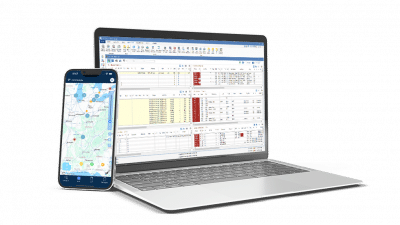
PCS handles all five of these inside the TMS. PCS IFTA reporting draws from actual dispatch mileage, with state-by-state jurisdiction calculation populated from fuel card data through the integration ecosystem. ELD integrations, including direct integration with Geotab, surface HOS data inside the PCS dispatch workflow so dispatchers work with current driver status without switching screens. Driver qualification file alerts and equipment maintenance schedules connect to the same system that runs daily dispatch. Documents captured through PCS Mobile attach directly to load records via electronic signature and camera capture from the road. When an auditor shows up, PCS compliance reporting pulls what you need from a single source.
Disconnected tools vs. TMS-native compliance: What changes
The practical difference between the two approaches shows up in the time it takes to complete five routine compliance tasks.
| Task | Tool outside TMS | TMS-native compliance |
|---|---|---|
| HOS check before dispatch | Open ELD dashboard, look up driver, return to TMS to assign | HOS status visible in dispatch screen; assignment blocked if driver is ineligible |
| IFTA quarterly filing | Export ELD mileage, reconcile with fuel card data, cross-reference TMS load records | IFTA report generated from dispatch mileage and integrated fuel card data |
| Driver record expiration alert | Check driver file tool on a separate schedule | Expiration surfaces as workflow alert tied to dispatch activity |
| Document retrieval for audit | Search ELD dashboard, email archives, physical files | Pull from load record; all documents attached at trip completion |
| Audit response on a specific load | Reconstruct from multiple systems; 20+ minutes per load | Single report pull; compliance record is the operational record |
The IFTA row is worth dwelling on. A quarterly filing that requires a manual ELD export, a fuel card reconciliation, and a cross-reference against TMS load records introduces three opportunities for discrepancy. Auditors who find those discrepancies recalculate fleet MPG downward, which increases tax liability beyond the original error. When mileage, fuel, and load data all live in PCS, the IFTA report and the operational record agree because they come from the same source.
Compliance overhead scales faster than your fleet
If you’re running 25 or more trucks across multiple states, the compliance overhead of disconnected systems scales faster than your fleet does. Every new driver, every new lane, every new piece of equipment adds another record that has to stay synchronized across tools that don’t talk to each other.
PCS keeps compliance inside the TMS: the same system your dispatchers use to assign loads, your accounting team uses to process settlements, and your drivers use to submit documents from the road. The PCS platform scales from 25 trucks to 1,000+ on the same architecture, so the compliance approach that works today doesn’t break when you grow. The compliance record and the operational record are the same record.
Schedule a demo to see how PCS works for a fleet your size.
Related Guide