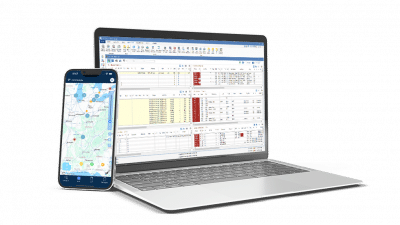
Before you pick a carrier TMS, first look at what the platform was designed to do. That choice shapes everything downstream. Some are, at heart, telematics and compliance systems. They track your trucks, log service hours, keep your ELD data clean, and flag risky driver behavior. Others are dispatch and accounting systems. They move loads, settle drivers, and invoice shippers out of a single database. Pick the wrong one for a 40-truck fleet, and you’ll end up bolting a second platform onto the first. That’s exactly the fragmentation you were trying to avoid.
The criteria that matter change with fleet size and operating model. A 500-truck carrier needs multi-terminal depth and can absorb a long implementation. Drop down to 60 trucks, and the priorities flip toward dispatch, driver settlement, IFTA, and billing in one place, without a dedicated IT team to run it. Freight brokers care more about carrier management and load tracking than about driver payroll. This guide maps seven platforms to those operating environments so you can match the tool to how your fleet actually runs.
Disclosure. PCS Software publishes this guide and ranks #4 on the list. All seven tools were scored the same way on dispatch depth, accounting and settlement, compliance and telematics, integration ecosystem, and fit by fleet size. We held PCS to the standard we applied to every other platform.
Key Takeaways
- Choose an all-in-one TMS (dispatch, accounting, settlement, and billing in a single database) if you run asset trucks and want to avoid re-entering trip data across systems.
- Choose a telematics-first platform (Samsara, Motive) when the main reason for buying is ELD compliance and driver safety scoring, with real-time tracking close behind, and native invoicing or driver pay can live in another system.
- Choose an enterprise TMS (McLeod or Trimble) if you run 500+ trucks, have dedicated IT, and operate complex multi-division operations. Expect long implementations and higher total cost.
- Choose a brokerage-focused TMS (Descartes Aljex) if brokered freight is your core business and you own few or no trucks.
- The deciding factor is really one question. Do you need native dispatch and accounting in a single system, or can you run a telematics platform integrated with a separate TMS? That single question rules more platforms in or out than any feature comparison.
How We Evaluated These Carrier TMS Tools
We scored every platform, PCS included, on the same criteria. The scores draw on two data sources: independent review sites (G2 and Capterra, weighted toward reviews dated 2025 or later) and hands-on product research into each platform’s features.
- Dispatch depth. Order management, load planning, and how much of the dispatch workflow lives natively in the platform rather than in a bolt-on.
- Accounting and settlement. Driver pay, settlements, invoicing, and IFTA, plus how tightly they tie back to what happens on the dispatch board.
- Compliance and telematics. ELD and hours-of-service handling, DVIR, and real-time tracking, whether the platform supports them natively or pulls them through an integration.
- Integration ecosystem. The ELDs, fuel cards, load boards, and TMS or telematics partners a platform connects to out of the box.
What Carrier TMS Software Does for a Growing Fleet
A carrier TMS manages the full load lifecycle, from booking and rating freight through assigning drivers, tracking trucks, settling driver pay, invoicing shippers, and reporting on cost and revenue per mile. The platforms below split on how much of that lifecycle they handle natively versus through integrations, a distinction PCS builds its whole platform around. Start by working out where each tool falls on that split.
| Capability | Why It Matters |
|---|---|
| Native dispatch + accounting | Eliminates double-entry between load close and invoicing, which can add 2-3 days to billing cycles |
| Driver settlement | Automated settlement, from pay to allocations to GL coding, cuts errors and speeds up driver paydays |
| ELD/telematics integration | Pulls HOS and DVIR data, plus live location, into dispatch without a separate login |
| Multi-modal support | TL, LTL, intermodal, and brokerage in one system if your operation spans modes |
| Scalability | Same platform from 25 to 1,000+ trucks avoids a costly re-implementation as you grow |
Carrier TMS Software Comparison Table
| Tool | Best For | Starting Price | G2 Rating | Key Differentiator | Watch-out |
|---|---|---|---|---|---|
| McLeod Software | Large carriers (500+ trucks) | Contact for pricing | 4.1/5 (42 reviews) | Enterprise-depth dispatch and BI for high-volume TL | Significant IT overhead; high total cost |
| Trimble TMS | Large fleets in the Trimble ecosystem | Contact for pricing | 3.7/5 (27 reviews) | Multi-product suite with telematics integration | Lowest rating in set; complex product lineup |
| Motive | ELD and safety-first fleets | Contact for pricing | 4.4/5 (3,109 reviews) | #1-rated ELD and AI dashcam, 350K+ vehicles | Not a full TMS; needs separate dispatch/accounting |
| PCS TMS | Mid-market carriers (25-500 trucks) | Contact for pricing | 4.2/5 (243 reviews, Capterra) | Native Cortex AI plus dispatch/accounting in one database | G2 review count is low; pricing not public |
| Samsara | Safety-first fleet management | Contact for pricing | 4.5/5 (4,552 reviews) | Most-reviewed platform; AI safety and ELD | TMS functions need partner integrations |
| Axon Software | Accounting-first carriers and brokers | Contact for pricing | 4.3/5 (6 reviews) | Comprehensive accounting/ERP with dispatch sync | Low review count; less modern UX |
| Descartes Aljex | Freight brokers and hybrid ops | Contact for pricing | 4.6/5 (434 reviews) | Highest rating; Macropoint-integrated brokerage TMS | Lacks native asset carrier accounting and driver pay |
1. McLeod Software: Best for Large Enterprise Carriers
McLeod’s LoadMaster has been the reference point for large truckload carriers for decades. It offers configurable workflows across dispatch, planning, driver management, and business intelligence and connects to a broad ecosystem ranging from MacroPoint to major ELD and telematics platforms.
Best fit. Carriers operating 1000+ trucks, with dedicated IT staff and complex, multi-division operations.
What we like. The enterprise depth is the real draw here. For high-volume TL carriers who need configurable planning and robust BI reporting, nothing else in this size class offers the breadth LoadMaster delivers.
What to watch. The same capability that serves large carriers becomes overhead below the 1000-truck threshold. Reviewers consistently cite long implementation timelines, meaningful IT investment, and a modular cost structure that scales up quickly. On G2, McLeod holds a 4.1/5 rating across 42 reviews, where users praise the functionality but flag configuration and implementation complexity.
Pricing. Contact for pricing. Widely seen as high-cost, with customization and support billed on top of the base license.
2. Trimble TMS: Best for Large Fleets in the Trimble Ecosystem
Trimble TMS spans a multi-product suite built from TruckMate and TMW. Suite, with Innovative IES, is designed for carriers seeking telematics and transportation management from a single vendor. It connects to MacroPoint, project44, and ISAAC Instruments and offers AI-assisted dispatch advice for load planning.
Best fit. Large carriers already invested in the Trimble ecosystem who want telematics and TMS from a single vendor.
What to watch. Trimble carries a 3.7/5 rating across 27 reviews on G2, the lowest in this set. Users praise the customization options but note that the multi-product setup means buyers have to determine which product best fits their operation. You deal with one vendor, though the underlying products do not add up to a unified platform.
What we like. For fleets that need both telematics and TMS and want a single-vendor relationship, the ecosystem’s breadth reduces vendor fragmentation, and the customization ceiling is high.
Pricing. Contact for pricing. G2 places the perceived cost at the highest tier.
3. Motive: Best for ELD Compliance and Driver Safety
Motive (formerly KeepTruckin) provides FMCSA-registered ELD compliance, AI dashcams, real-time GPS tracking, and driver safety coaching across a network of 350,000+ vehicles. G2 named it #1 in Fleet Management across several segments in Spring 2025, and it carries strong independent validation.
Best fit. Mid-market fleets whose main reason for buying is safety scoring and HOS compliance, with tracking close behind, and where dispatch and accounting can sit elsewhere.
Key features.
- FMCSA-registered ELD with automated HOS logging
- AI dashcams detecting 15+ unsafe driving behaviors
- Real-time GPS and vehicle health monitoring
- Automated driver safety coaching
Customer signal. Motive holds a 4.4/5 rating across 3,109 reviews on G2 and a 4.5/5 rating across 1,688 reviews on Capterra, two of the largest review bases in the category.
What to watch. Motive is a fleet safety platform that stops short of being a full TMS. It has no native dispatch order management, driver settlement, invoicing, or carrier accounting. Carriers that need load management and backhaul optimization alongside safety tools will connect Motive to a separate TMS, adding cost and integration work. Capterra reviewers also flag inflexible pricing and contract terms.
Pricing. Contact for pricing.
4. PCS TMS: Best for Mid-Market Carriers Needing All-in-One
PCS TMS is a native, all-in-one transportation management system that combines dispatch, accounting, driver settlement, fleet management, IFTA, and Cortex AI into a single database. PCS serves mid-market carriers operating in truckload, LTL, intermodal, or asset-based brokerage. Since 1996, PCS has built its workflows around how trucking operations actually run on the ground.
Best fit. Medium and enterprise carriers who want dispatch, accounting, settlement, and AI automation in a single system without enterprise-level costs or implementation overhead.
Key features.
- Cortex AI analyzes 36+ data points for one-click driver matching
- Native carrier accounting with automated settlement and IFTA reporting
- 70+ integrations, from ELDs and fuel cards to the major load boards
- TL, LTL, intermodal, and brokerage in one platform
What we like. Because Cortex AI is built directly into the platform, load scoring and driver recommendations run inside the dispatch workflow that dispatchers already use. Cortex analyzes 36+ real-time data points for each driver and the lanes on offer to recommend the best match, reducing tender-to-dispatch time from minutes to seconds. The accounting integration removes the double-entry between load close and invoicing, which otherwise adds days to billing cycles elsewhere. PCS reports a 20-30% accounting productivity increase and a 2-3 day reduction in days-to-close.
Proof point. One customer, RDX LLC, cut days sales outstanding by 8-12 days after moving to PCS.
Customer signal. On Capterra, PCS holds a 4.2/5 rating across 243 reviews. “The system is as user-friendly as it gets,” writes Ron B., a safety manager in the trucking industry. “Anything you can’t figure out, one simple and quick phone call will get you the answers you are looking for.” (Capterra, April 2025)
What to watch. The G2 profile has only 7 reviews at 4.4/5, so buyers who rely heavily on G2 should treat the Capterra profile (243 reviews) as the stronger validation signal. Pricing is not publicly listed, and the platform is best suited to fleets of roughly 25 trucks. Smaller operations may find its depth exceeds what they need.
Pricing. Contact for pricing. No free trial.
5. Samsara, Best for Safety-First Fleet Management
Samsara is a telematics and fleet safety platform with strong ELD compliance, AI dashcams, and real-time visibility into the fleet. With 4,552 G2 reviews, it carries the largest independent validation base in this category and connects to 161 integrations, including TMS partners.
Best fit. Carriers whose primary need is fleet safety and ELD compliance, plus telematics visibility, especially multi-industry physical operations fleets.
What we like. The safety and telematics capabilities lead the category. AI dashcams detect 15+ unsafe behaviors with real-time alerts, and ELD compliance is highly rated by a very large review base. Samsara holds a 4.5/5 rating across 4,552 reviews on G2.
What to watch. Samsara leads with telematics. Full TMS functionality (native dispatch, settlement, invoicing, and backhaul management) is delivered via integrations, so it sits outside the core platform. Carriers who need all of that in one place will run Samsara next to a separate TMS, and the combined cost is a real consideration. Users also flag high, inflexible pricing.
Pricing. Contact for pricing.
6. Axon Software, Best for Accounting-First Carriers
Axon offers a TMS built around real-time integration between dispatch and accounting, with a strong reputation for financial depth across driver pay, settlements, cash flow, and profitability visibility. It appeals to carriers and brokers, including cross-border and Canadian operations.
Best fit. Carriers and brokers who put accounting and ERP-level financial management first.
What we like. The dispatch-to-accounting sync is real-time, and users credit the training-supported onboarding for getting teams productive. “At first, it looks like a lot to learn,” writes Margaret F. in office administration, “but with the amazing training they provided, we’ve been more efficient and quicker.” (G2, October 2025)
What to watch. Axon’s G2 profile carries only 6 reviews at 4.3/5, so independent validation is thin compared to the larger platforms here. Reviewers describe it as feature-rich but complex to onboard, with a less modern interface than cloud-native competitors and a Canadian development focus that means US-specific workflows require additional configuration.
Pricing. Contact for pricing.
7. Descartes Aljex, Best for Freight Brokers and Hybrid Operations
Descartes Aljex is a brokerage-focused TMS built for freight brokers and 3PLs managing carrier loads, with integrated MacroPoint tracking and EDI automation on top of solid carrier management. It carries the highest G2 rating in this list.
Best fit. Freight brokers and asset-plus-broker hybrid operations that need strong carrier management and tracking more than driver payroll.
What we like. Aljex holds a 4.6/5 rating across 434 reviews on G2, a strong volume for a freight-focused TMS. Users praise the MacroPoint integration for tracking, EDI automation, and carrier management workflow. One G2 reviewer calls it “the best all-in-one TMS we’ve used.”
What to watch. Aljex is purpose-built for brokerage. It lacks the depth in native carrier accounting, driver settlement, fleet management, and ELD that asset carrier platforms provide. Pure asset carriers will hit gaps around IFTA and driver pay.
Pricing. Contact for pricing.
Worth a look: TenTrucks is a newer, simplicity-focused TMS aimed at small to mid-size fleets and owner-operators, built around real-time dispatch, load tracking, and fleet maintenance, with integrations into QuickBooks, Motive, Samsara, and major fuel card providers. It’s a lighter option worth a look if you want dispatch and tracking without the learning curve of a larger platform.
What Carrier TMS Software Costs
Almost no vendor in this category publishes a price, which is why every row above reads “Contact for pricing.” That does not make cost unknowable. It makes it a function of a few variables you can reason about before you ever get on a sales call.
Most carrier TMS vendors price on one of three models. Per-truck pricing scales with your fleet size and is most common among mid-market all-in-one platforms. Per-seat pricing tracks how many dispatchers, accountants, and managers log in, which tends to favor larger fleets running lean back offices. Module-based pricing charges a base license plus add-ons for accounting, safety, or brokerage, and is the usual pattern for enterprise systems.
A handful of factors move the final number more than headcount alone:
- Modules and modes. Adding accounting, safety, or brokerage to a base dispatch license raises the price, and so does spanning TL, LTL, and intermodal within a single system.
- Integrations. ELD, fuel card, load board, and EDI connections sometimes incur setup or per-connection fees in addition to the license.
- Implementation and training. Enterprise systems bill separately for configuration, data migration, and onboarding. Cloud-native mid-market tools fold more of that into the subscription.
- Contract length and support tier. Multi-year commitments and premium support change the effective monthly rate.
Broadly, three tiers hold. Enterprise systems like McLeod and Trimble sit at the top once customization and support are added, and they assume you have IT to run them. Mid-market all-in-one platforms like PCS and Axon land below that, since there are no separate modules to license and no servers to stand up. Telematics-first platforms like Samsara and Motive look inexpensive on their own, but if you also need dispatch and accounting, you are paying for a second system beside them, so compare the combined cost rather than the sticker.
How to Choose the Right Carrier TMS
A few concrete filters settle the decision.
- Choose McLeod or Trimble if you run 500 or more trucks with dedicated IT and need enterprise-depth configuration. Budget for a long implementation and higher total cost.
- Choose Motive or Samsara if your primary need is ELD compliance and safety scoring, with telematics on top, and you’re comfortable wiring in a separate TMS for dispatch and accounting.
- Choose Descartes Aljex if brokered freight is your core business and you own few or no trucks.
- Choose PCS TMS if you run 25-500 asset trucks and want native dispatch, accounting, settlement, and AI in one database without enterprise overhead.
- Choose Axon if accounting and ERP integration are your top priorities and you can absorb heavier onboarding.
One question rules most of these in or out. Do you need native dispatch and accounting in a single system, or can you run a telematics platform alongside a separate TMS? Answer that first, and your shortlist gets a lot shorter.
If you’re a mid-market carrier weighing an all-in-one TMS, the fastest way to assess fit is to see dispatch and accounting workflows in one place.
PCS Software provides native dispatch, accounting, settlement, and Cortex AI for carriers running 25 to 1,000+ trucks. Request a demo and bring your hardest dispatch scenario.
For a deeper look at the trade-offs, see our guide on choosing the right TMS platform and on how AI dispatch software affects dispatcher capacity.
Frequently Asked Questions
A telematics-first platform (Samsara, Motive) is built around tracking trucks and keeping them ELD-compliant, with driver safety layered in. A full TMS is built around moving loads, so it handles dispatch, driver settlement, invoicing, and carrier accounting within a single database. Telematics platforms cover full TMS functions through integrations, so carriers who need dispatch and accounting in one place will run a second system alongside them.
Yes, and many fleets do. A carrier can run Samsara or Motive for ELD and safety, then connect a separate TMS for dispatch and accounting. The tradeoff is running two systems and paying for the integration between them. Fleets that want dispatch, accounting, settlement, and telematics data in one place tend to consolidate onto an all-in-one TMS as they grow.
Look for a platform that handles asset carrier operations (dispatch, settlement, IFTA, driver pay) and brokered freight within a single system. Brokerage-focused tools like Descartes Aljex are strong on carrier management but light on asset accounting. All-in-one platforms like PCS TMS run truckload, LTL, intermodal, and asset-based brokerage in a single database, which better supports hybrid operations.
Most platforms in this category do not publish pricing. They quote based on fleet size and the mix of modules and integrations you need. Enterprise systems like McLeod and Trimble carry higher total cost once you add customization and support on top of the base license. Mid-market all-in-one platforms usually come in below enterprise tiers because there are no separate modules to buy.
Implementation time scales with platform complexity. Enterprise systems like McLeod and Trimble require the longest timelines and significant IT investment due to their depth of configuration. Cloud-native mid-market platforms are implemented faster because there are no servers to stand up and fewer modules to configure. Ask any vendor for a specific timeline tied to your fleet size and mode mix.