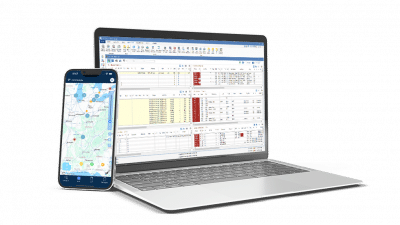
TL;DR: How to reduce transportation costs with TMS starts with stopping the bleeding. You’re losing money on carrier rates nobody compared, routes nobody optimized, and invoices nobody checked. A TMS catches this stuff automatically. The savings are sitting in your freight spend right now.
How to reduce transportation costs with TMS starts with your Chicago-Atlanta lane. It costs more this week than last week. Not because rates went up. Because nobody had time to call around for quotes, the same carrier was assigned the load again. At whatever price they chose to charge.
Dispatch doesn’t know where half the trucks are. Drivers check in when they remember to. When a delivery window gets tight and nobody’s sure if the truck will make it, you pay for expedited service. That $150 upcharge? That’s what visibility costs when you don’t have it.
Three shipments are going to Dallas this week. Nobody realizes they could ride on one truck because they’re in different systems, managed by different people. Three LTL shipments: $1,860. One truck: $1,950. You’re literally paying more to make it harder.
This is happening on hundreds of loads. A TMS fixes it by putting everything in one place where the software can spot the problems.
Why Transportation Budgets Keep Expanding
Manual freight management wasn’t built for today’s shipping volumes. Rate shopping manually scales poorly when you’re tendering 200+ loads per week.
Dispatch operates on estimated delivery times and driver check-ins collected through phone calls or macro updates sent three times daily. When nobody has verified the truck’s location in six hours, expedited service becomes the safe choice. That $150 premium pays for visibility you don’t have. Teams choose service upgrades to compensate for information gaps, converting a data problem into a recurring cost problem.
Consolidation opportunities disappear when different departments manage shipments in separate ERP systems or spreadsheets. The aggregate weight might total 38,000 pounds, easily filling a truckload at $1,850, but split into three LTL shipments at $620 each, you’re paying $1,860 for worse service.
These inefficiencies compound across hundreds of shipments. Expedited freight covers visibility gaps. Contract rates go unvalidated month after month. Accessorial charges get paid without verification.
How TMS Cuts Freight Costs: Manual vs Automated Operations
| Cost Driver | Manual Process | TMS Automation | Typical Savings |
|---|---|---|---|
| Carrier rate comparison | Call 3-5 carriers per load, 30+ min | Instant comparison across all contracted carriers | 10-25% per shipment |
| Route planning | Dispatcher plots routes based on experience | Algorithm evaluates thousands of route combinations in seconds | 15-20% fewer miles |
| Load consolidation | Visible only within single department/system | Automatic matching across all shipments by destination and timing | $750 per consolidated load |
| Invoice auditing | Spot-check 10-20% of invoices manually | Every invoice validated against contracted rates | 3-5% freight spend |
| Carrier selection | Based on availability and relationship | Ranked by acceptance rate, on-time delivery, and price | 8 min vs 35 min to acceptance |
| Mode selection | Default to familiar mode (usually LTL or truckload) | Compares LTL, truckload, intermodal with all-in costs | 15-30% on flexible shipments |
Strategy 1: Automated Carrier Rate Comparison
Carriers price the same lane differently. Sometimes way differently. They bid low when they’ve got trucks deadheading back anyway. They bid high when they don’t.
Your regular carrier quotes $1,400. The TMS finds another at $1,380. Looks cheaper. Then the fuel surcharge kicks in (this carrier calculates it differently). Minimum charge applies because the load’s over 10,000 pounds. Actual bill? $1,500. You just paid $100 more for the “cheaper” option.
The TMS catches this because it knows every carrier’s surcharge formula, every minimum, every accessorial trigger. You book based on what the invoice will actually say.
Carriers don’t charge per mile anymore. They charge based on ZIP pairs, weight breaks, equipment type, fuel indexes that change weekly. Your TMS needs all of it, current, or it’s guessing. Carrier management tracks contract rates, performance, and billing accuracy in one place.
Strategy 2: Multi-Stop Route Optimization
Three Dallas deliveries over three days means three round trips. Each truck drives out, makes one stop, and comes back empty. You’re burning fuel on 420 miles of deadhead.
One route hitting all three stops in one day? 380 miles total. Same deliveries, 460 fewer miles, two fewer driver days.
The system figures this out in seconds. Stop C has a two-hour delivery window. I-405 adds 45 minutes during rush hour. Your driver hits hours-of-service limits if traffic delays push them past their 14-hour window.
Basic route systems measure straight-line distance and guess. Better systems know the actual roads, the actual traffic, the actual constraints. Route optimization consolidates multi-stop loads into fewer trips.
Strategy 3: Shipment Consolidation Based on Timing and Destination
Six shipments to the Dallas area. Split them up as LTL and you’re paying $2,700. One truck? $1,950. That’s $750 per week, $39,000 per year on one lane.
Most companies miss this because the six shipments live in different systems. A TMS spots them automatically (same destination within 50 miles, ready within two days).
Weight and cube constraints
Weight says they fit. Cube says you’re at 73% capacity. That’s before you account for stackability. Can’t put 800-pound glass pallets on top of chip boxes. Can’t mix hazmat classes. Can’t run frozen with ambient. The TMS needs to know all of it or the “consolidation” gets rejected at the dock.
Real costs of holding freight
Holding freight to consolidate saves money but costs time. Wait three days to fill the truck, and you save $800 on freight. But you’re storing pallets for three days at $3 each, handling them twice adds another $40 in labor. Actual savings after storage and handling? Closer to $700. Still good, but not the $800 the rate sheet promised.
LTL optimization helps shippers consolidate orders and maximize trailer utilization.
Strategy 4: Automated Freight Bill Auditing
LTL carriers bill 40 to 60 different accessorial charges. Liftgate, residential delivery, limited access, redelivery, inside delivery. Each one costs $75 to $150. Each one should only apply when you actually need that service.
Carriers get it wrong. Data entry errors, aggressive interpretation of what counts as “limited access,” and straight-up mistakes. Without an audit, you pay it.
Fuel surcharges change by carrier. One charges half a percent per penny over $1.50 per gallon. Another charges 0.4% per penny over $1.30. When diesel hits $3.50, you’re looking at different surcharge rates. On a $1,000 shipment, that’s $120 difference.
The system checks every line item against your contracted rates. Carrier charged $1.85 per mile when your contract says $1.72? Flagged. Applied a liftgate charge on a dock delivery? Flagged. Billed the same load twice? Flagged.
Companies set up audit rules at go-live, then forget about them. Carriers change fuel surcharge formulas twice a year. Accessorial fees get updated annually. Six months later, your audit accuracy drops because you’re checking against old data. Automated freight audit keeps the rules current.
Strategy 5: Transportation Mode Selection and Cost Comparison
Same shipment, different options:
- LTL: $680, five days
- Partial truckload: $920, three days
- Intermodal: $510, seven to nine days
Intermodal looks cheap until you add drayage. Drayage costs $250-400 per move. Your dock’s 80 miles from the ramp? That $510 intermodal rate just became $1,100.
LTL has accessorial exposure. Residential delivery, liftgate, and limited access can add a third to your bill. The TMS factors this in based on where these charges hit historically. True LTL cost isn’t $680 (it’s $900 after the accessorials come your way).
Transit time matters when your customer needs the product on day nine, and intermodal runs seven to eleven days. That variance creates risk. Truckload delivers in three days, every time.
Strategy 6: Predictive Carrier Tender Acceptance
Tendering loads manually burns time on carriers who say no. You call the cheapest carrier. They reject it. You call it the second cheapest. They reject it. Thirty minutes later, you’re in the spot market paying 40% over contract rates because you’re out of time.
Carrier A takes most of your Chicago-Atlanta loads. Rejects half your Miami runs. The pattern shows they’ve got backhaul density in Atlanta but struggle in Miami. The system ranks them lower for Miami, and saves you the wasted call.
The system ranks carriers on who takes your loads, delivers on time, and bills clean. Time from tender to acceptance drops from 35 minutes to eight. Dispatch automation handles the sequencing.
TMS Implementation: Where Cost Savings Actually Come From
Clean data fixes things. Rate tables full of errors and poison optimization. ZIP 60601 with city “Springfield” instead of “Chicago”? The system thinks Springfield is downtown Chicago, calculates 150 fewer miles than reality, and gives you cost estimates that don’t match invoices.
Track who’s actually using the system. The percentage of shipments using TMS-recommended carriers should hit 85%. If dispatchers override 40% of recommendations, either they’ve got valid reasons or they don’t trust the system. Require reason codes to tell the difference.
Show value fast. Flag recommendations that differ by $100 or more. “You usually use Carrier A for $1,850. System recommends Carrier B for $1,520. Take it?” That $330 difference builds trust.
Quarterly reviews keep it working. Which carriers beat their transit times? Which ones are clean? Which ones take your tenders? Use the data to negotiate better rates with good carriers. Reporting tracks it.
PCS Built This for People Who Move Freight
PCS Software configures TMS for your operation. You see savings within 90 days. The system tracks spend before and after, breaks down where the money came from.
Get a demo and see where your freight budget’s leaking.