TL;DR:
- The trucking industry ran a record 16.7% deadhead rate in 2024 while average truckload margins turned negative.
- Most carriers track rate per loaded mile, a metric that makes empty miles invisible until they show up in the fuel bill.
- AI addresses deadhead at two distinct points in the dispatch cycle: before pickup, by recommending drivers whose current position minimizes total empty miles, and after dispatch, by automating backhaul sourcing while the outbound load is still moving.
This guide covers both.
What Does 16.7% Deadhead Actually Cost a Mid-Market Carrier?
Deadhead hit a record high in 2024 at the same moment margins went negative.
ATRI’s July 2025 operational costs report puts the industry average at 16.7% of all truck miles driven empty, up from 16.3% the year prior. Truckload sector average operating margin that same year was -2.3%. Those two numbers belong in the same sentence because they explain each other. The industry ran more empty miles than at any point in the post-pandemic cycle and simultaneously lost money on average per truck.
At $2.26/mile total operating cost and an industry-average 82,677 annual miles per truck, 16.7% empty translates to roughly $31,200 per truck per year, generating zero revenue.
For a 25-truck fleet, that’s approximately $940,000 per year producing nothing. That figure is conservative: it excludes the loads that went to a competitor because the nearest available truck was deadheading away from the market.
But it doesn’t have to be this way.
Is Rate Per Loaded Mile Hiding the True Cost of Your Empty Miles?
Rate per loaded mile is the default KPI on most dispatch boards, and it hides the most controllable cost in your operation.
Dispatchers see it for every load, use it to rank opportunities, and quote it to customers. But loaded-mile rate only counts revenue against miles driven with a paying load. The miles a driver travels from their current position to the pickup location drop out of the calculation entirely. If your dispatchers are evaluating two competing loads using loaded-mile rate alone, they’re missing the variable that often determines which load is actually more profitable.
Non-fuel operating costs hit a record $1.779 per mile in 2024, up 3.6% year over year. Every empty mile now carries a higher per-mile loss than it did two years ago. Running a truck empty at $2.26/mile total operating cost is more destructive to margins than the same empty mile in 2022. The measurement problem is old. The cost of ignoring it is new.
How pre-pickup deadhead distorts your all-miles rate
A $3.00/mile load can be less profitable than a $2.60/mile load depending on where the driver starts.
Walk through the math on two competing loads.
- Load A pays $3.00/mile but requires 200 deadhead miles to reach the pickup. Load B pays $2.60/mile with only 50 deadhead miles. On loaded miles, Load A looks better by $0.40/mile. When you calculate revenue against total miles (loaded plus deadhead), Load A drops to approximately $2.40/mile.
- Load B lands at $2.45/mile. The “lower-rate” load is the more profitable one.
That math plays out across hundreds of assignments per month. Over a 25-truck fleet averaging 300 loads per month, a consistent $0.05/mile miscalculation on load selection compounds to $18,000 to $25,000 per year in margin left on the table, depending on average haul length. Most operations never see this number because the standard KPI wasn’t designed to capture it.
Pre-pickup deadhead is the type most industry discussion overlooks.
Post-delivery empty miles get the attention. Pickup deadhead is the blind spot. The distinction matters because the solution is different: driver matching AI addresses pre-pickup deadhead by selecting the driver whose current position minimizes total empty miles.
The total-mile calculation that changes which loads to accept
Margin per total mile makes deadhead visible at the assignment level. The formula is straightforward: load revenue divided by the sum of loaded miles plus deadhead miles to pickup. When dispatchers compare two competing opportunities using this calculation rather than loaded-mile rate, lower-rate loads with better driver positioning frequently outperform higher-rate loads with heavy pickup deadhead.
At record-high non-fuel operating costs, the gap between these two calculations is wider than carriers have historically experienced. A carrier running 20% deadhead at current operating costs is carrying $8,000 to $10,000 per truck per year in margin erosion that loaded-mile metrics will never surface. The fix isn’t dispatcher discipline. Most dispatch boards default to displaying loaded-mile rate because that’s what the TMS was configured to show. The fix is a system that factors total miles into every recommendation before the dispatcher sees the load.
Why Does the Type of Deadhead Determine Whether AI Can Fix It?
- Pre-pickup deadhead: miles driven from the driver’s current position to a load’s pickup origin. This is the repositioning problem, and it occurs at assignment time before the load moves. AI addresses it by factoring driver location, HOS status, lane history, and equipment type into driver recommendations, selecting the driver whose current position minimizes total empty miles for that specific assignment. The key constraint: this requires AI drawing from live ELD data, not self-reported driver status or synced snapshots. A driver’s location and available hours change continuously, and HOS calculations based on data that’s even two hours old can produce assignments a driver can’t legally complete.
- Post-delivery deadhead: the empty return trip after drop-off.
This is what most carriers mean when they talk about deadhead. The truck delivers, the driver runs empty, and dispatch scrambles for a return load. AI addresses this through backhaul automation: identifying profitable return legs and initiating shipper outreach before the delivery happens rather than after. “Before delivery” versus “after delivery” is the mechanism difference, and it determines whether good loads are available or already gone. - Most AI tools in the market address only one type.
Route optimizers and load boards focus on post-delivery positioning. Add-on backhaul tools surface return opportunities but don’t adjust driver selection at the assignment stage. A native TMS with embedded AI can address both because driver matching and backhaul sourcing draw from the same live data. HOS status, driver location, lane history, and pending return legs are all visible in one system at the moment an assignment is made. That shared data layer is why architecture matters more than any individual AI feature.
Why Starting Backhaul Sourcing After Delivery Costs You the Best Return Loads
Manual backhaul sourcing faces a structural timing disadvantage that removes the best freight from the table before a dispatcher can act.
When a dispatcher starts sourcing a return load after delivery confirmation, two things have already happened. The truck is running empty, generating $0.55 to $0.75 per mile in direct fuel cost alone with no revenue. And the best-paying return loads have been claimed by carriers whose systems got there first. Freight broker markets price available capacity in real time. A return lane that pays $2.80/mile at 2 pm while the truck is still loaded might pay $2.20/mile at 5 pm when three other empty trucks are competing.
The profitable backhaul window opens at dispatch, not at delivery.
When an outbound load is assigned, the driver’s likely delivery time, approximate post-delivery location, and available hours on the next shift are all known. That’s the moment to begin backhaul sourcing: hours before the truck empties, while good loads are still available at full rates. Acting on this insight reliably, across every truck on every shift, without requiring dispatcher time, is what AI makes operationally feasible.
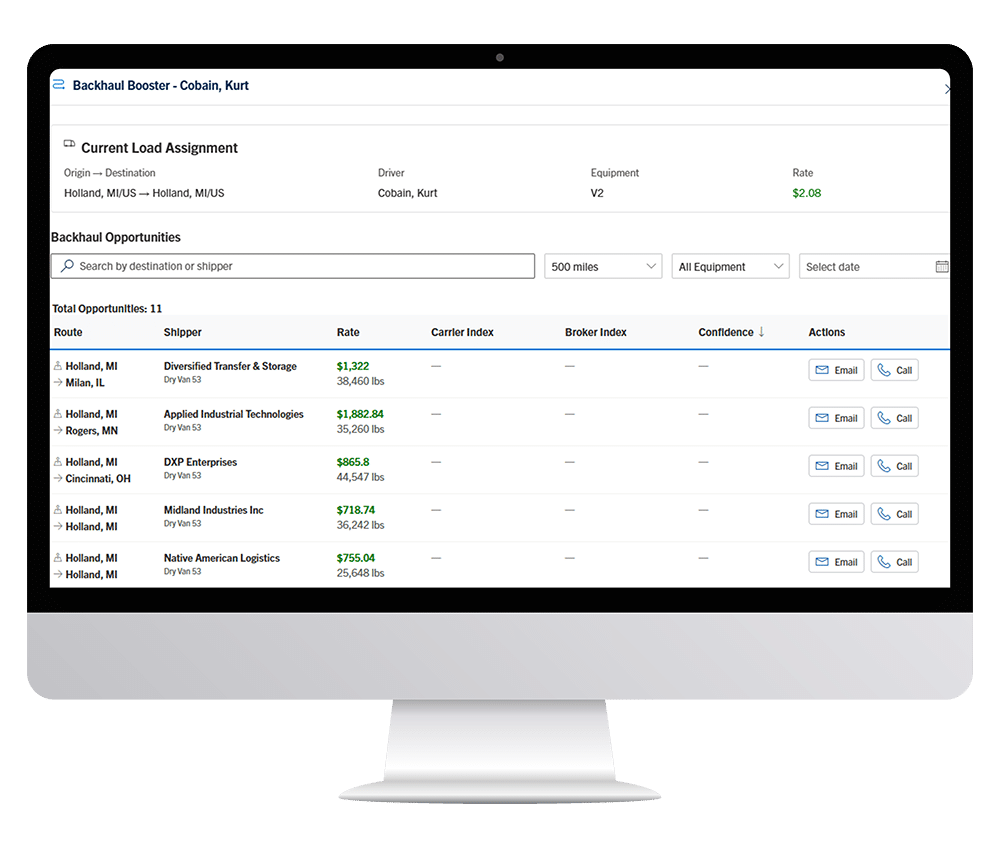
PCS Backhaul Booster closes the timing gap by running outreach before the truck goes empty. Cortex AI identifies profitable return legs while the outbound load is still in motion, then automatically contacts shippers via AI-generated email or voice call before delivery confirmation. Dispatchers stay in the decision loop, but the outreach requires none of their time. Royal Logistics (100 trucks, 240 trailers) went from approximately three hours per day of manual backhaul sourcing to having the process run automatically in the background.
Open load boards are amplifying carrier deadhead.
DAT Solutions found 30 to 45% of loads posted on open boards never move through the platform where listed. Carriers repositioning trucks based on posted availability often find the freight gone or mispriced by the time they arrive. Backhaul strategy built around closed, predictive sourcing systems operating on verified freight demand consistently outperforms open board availability that may be stale.
How Much Can AI Actually Reduce Deadhead Miles?
FreightWaves benchmarks give carriers a calibration point worth knowing by heart: under 15% deadhead as a percentage of total miles is good performance, under 10% is excellent, and over 20% is a cash leak. The 2024 industry average of 16.7% puts most carriers in the lower tier of acceptable performance. A carrier at 22% has an $8,000 to $10,000 per truck per year problem, depending on lane mix and annual mileage. At 25 trucks, that’s $200,000 to $250,000 in recoverable margin.
Documented AI results cluster in the 10 to 16% reduction range for mid-market carrier deployments, though where a specific carrier falls depends on ELD integration quality, data completeness in the TMS, and whether AI covers both driver matching (pre-pickup deadhead) and backhaul automation (post-delivery deadhead). Carriers that deploy only one mechanism typically land at the lower end.
| Metric | Source | Result | What It Measures |
|---|---|---|---|
| AI capacity utilization gain | Roland Berger (via Gitnux 2026) | +16% | Fleet-wide utilization across AI deployments |
| AI load matching reduction | England Logistics | 10 to 15% fewer empty miles | Mid-market carrier empty mile reduction |
| Dispatcher time recovered | PCS case study: Royal Logistics | 3 hours/day eliminated | Manual backhaul sourcing replaced by automation |
Royal Logistics eliminated three hours of daily backhaul sourcing without adding headcount. Cortex AI and Backhaul Booster removed all manual work. Director of Operations Kaleb Groce’s team now has those hours available for exceptions, customer relationships, and managing growth. That’s the real capacity gain: dispatcher time shifts from reactive sourcing to proactive operations.
What Should You Ask Before Buying an AI Tool for Deadhead Reduction?
- Does backhaul sourcing start at dispatch or at delivery? The answer reveals whether the tool is designed around the timing problem or around the outcome of finding a load. A tool that only surfaces return loads after delivery confirms is operating inside the losing window, by definition.
- Does the system contact shippers automatically, or does it surface opportunities for a dispatcher to act on? Surfacing an opportunity still requires dispatcher time. Automated outreach via AI email or voice call removes that constraint entirely. The distinction determines whether the tool saves time or eliminates the task.
- Does AI draw from live TMS data or from data synced from a separate system? Driver location, HOS status, and available loads change continuously. AI recommendations that rely on synced snapshots have lag built in. A native TMS with embedded AI has no sync gap because dispatch, accounting, fleet data, and the AI engine share one database.
- Are dispatch and accounting in the same system? Carriers can’t continuously measure total-mile profitability when load revenue and empty-mile counts live in separate systems that require manual reconciliation. The measurement problem from earlier in this article is only solvable when the data is unified.
Reduce Deadhead Miles Before Margins Tighten Further
PCS was built around these four questions. Cortex AI runs inside the same database your dispatchers use every day, analyzes 36 data points on every assignment, and Backhaul Booster contacts shippers before the truck goes empty.
If your fleet is running above 15% deadhead, see what Cortex AI looks like on a live dispatch board.
Frequently Asked Questions About Reducing Deadhead Miles with AI
FreightWaves benchmarks put under 15% as good and under 10% as excellent. The 2024 industry average was 16.7%, according to ATRI. Most carriers only check this number monthly or quarterly. Real-time deadhead tracking at the assignment level is the operational difference between hitting benchmarks and just reporting against them.
AI reduces deadhead through two mechanisms. Driver matching uses live data including location, HOS remaining, lane history, and equipment type to recommend the driver whose current position minimizes total empty miles on a specific assignment. Backhaul automation identifies profitable return legs and contacts shippers via email or voice before the outbound delivery completes, so trucks reload before they go empty rather than after.
Pre-pickup deadhead is the miles a driver travels from their current location to a load’s pickup origin. Post-delivery deadhead is the empty return trip after drop-off. Most industry discussion focuses on post-delivery deadhead. Pre-pickup deadhead is often invisible because it doesn’t appear in rate-per-loaded-mile calculations, but it directly affects total-mile profitability on every assignment.
Not entirely, but carriers shouldn’t build their backhaul strategy around them. A 2024 DAT Solutions market report found 30 to 45% of posted loads never move through the platform where listed. Repositioning a truck based on phantom availability generates deadhead chasing freight that won’t materialize. The carriers running under 10% deadhead in 2026 use predictive sourcing from verified shipper relationships as their primary channel, with load boards as a supplemental fallback.
Backhaul Booster is PCS’s automated backhaul sourcing tool within Cortex AI. It identifies profitable return legs for outbound loads while the truck is still in transit, then fires AI-generated email or voice outreach to shippers before delivery confirms. Dispatchers don’t have to initiate the search or make the contact. Royal Logistics (100 trucks, 240 trailers) went from approximately three hours of daily manual backhaul sourcing to running the process automatically in the background.
Related Guide