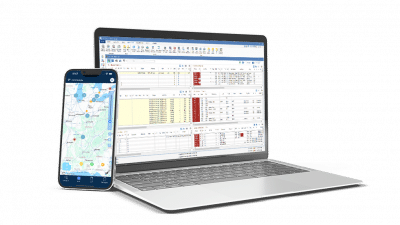
AI in transportation and logistics is transforming how freight is planned, moved, and delivered across the supply chain.
With AI in transportation and logistics embedded directly into core systems, teams move beyond dashboards to a true decision engine that drives speed, accuracy, and profitability. That means faster forecasts, smarter load matching, and automated back-office work that cuts out wasted hours and empty miles.
But adoption isn’t automatic. Many logistics operations still struggle with siloed data, disconnected systems, and uncertainty about which tools actually use AI versus marketing the label. The key is choosing solutions where AI is built in, not bolted on — platforms that unify workflows instead of layering complexity.
This post breaks down the top AI applications across the supply chain, the barriers holding teams back, and how to determine the current technology on the market.
What is AI in Transportation and Logistics?
AI in transportation and logistics is the use of machine learning and automation to improve planning, execution, and delivery across the supply chain.
It takes in large amounts of data and turns it into faster, more accurate decisions. This could include demand signals and fleet telematics, to driver behavior and market conditions.
Unlike static schedules or manual updates, AI systems adapt as conditions change. They can forecast demand shifts, reroute loads, and flag safety or compliance risks without adding more work for dispatchers or drivers.
Here are ways AI in transportation and logistics shows up across the process:
- Warehouses: AI forecasts demand at the SKU level, slots inventory where it moves fastest, and predicts labor needs to reduce overtime and bottlenecks.
- Freight movement: Algorithms match loads to trucks or containers based on availability, cost, and location, cutting empty miles and reducing tender rejections.
- Fleet operations: Telematics data feeds into AI models that monitor driver safety, fuel use, and maintenance trends, flagging issues before they become breakdowns or violations.
- Last mile: AI predicts delivery windows using traffic, weather, and stop history, then updates customers automatically to reduce failed deliveries and service calls.
AI in transportation and logistics can support teams by turning fragmented data into clear, actionable insights. Stronger signals give dispatch, fleet, and customer service teams the space to plan with confidence and keep freight moving efficiently. Unlike static schedules or bolt-on scripts, embedded AI adapts as conditions change — forecasting demand, rerouting freight, and flagging risks in real time.
Next, let’s look at the core applications where AI is already creating measurable impact across transportation and logistics.
Top AI Applications in Transportation and Logistics for Supply Chain Optimization
How does AI improve demand forecasting in logistics?
Forecasting demand is one of the hardest problems in logistics.
Relying on historical averages or spreadsheets can leave fleets over-committed one week and underutilized the next.
AI models analyze a broader set of signals. These signals can be market rates, seasonality, customer orders, or even external data like weather or fuel prices. The result is a more accurate forecast of what capacity will be needed and where.
For carriers, this reduces empty miles and deadhead by positioning equipment closer to demand. For shippers, it means fewer stockouts and a tighter grip on freight spend.
Dynamic pricing and rate management
Freight rates shift constantly. Manual contracts and delayed updates can reduce carrier profitability and create unpredictable costs for shippers.
AI pricing tools process live data, including lane demand, fuel costs, capacity availability, and market indexes. This is to set rates that reflect real conditions. This helps carriers stay competitive without undercutting margins and gives shippers faster visibility into true market pricing.
The benefit is tighter alignment between cost and value. Shippers get fair, data-driven pricing while carriers improve profitability by avoiding guesswork or outdated rate sheets.
Real-time load optimization
Empty miles and underutilized equipment are some of the biggest cost drains in logistics. Traditional planning methods rely on manual matching. This can slow down the workflow and lead to missing backhaul opportunities.
Dispatch powered by Cortex takes real-time load optimization further. Instead of dispatchers juggling spreadsheets, the system weighs over 35 factors — including driver HOS, equipment type, proximity, and profitability. From there, dispatchers can reserve or assign a load with one click, or let Cortex fully automate the process.
The result is higher asset utilization for carriers and more reliable coverage for shippers.
What is digital twin modeling in logistics and how does AI enhance it?
A digital twin is a virtual model of your supply chain that lets you test scenarios without disrupting live operations. With AI, these models simulate the impact of changing demand, capacity shifts, or network disruptions in real time.
For example, logistics teams can see how rerouting freight around a closed port will affect costs, lead times, and downstream deliveries. They can also test different warehouse configurations or inventory levels before making expensive changes.
This reduces risk and helps teams make data-backed decisions faster.
Driver behavior analysis and safety monitoring
AI in transportation and logistics works on two major fronts: optimizing freight and improving safety. Telematics data combined with machine learning can surface patterns like harsh braking, speeding, or long idle times.
Managers use this insight to coach drivers and lower fuel costs. Insurers and regulators also benefit from documented safety improvements, often leading to reduced premiums and fewer compliance issues.
For fleets, better safety performance translates into fewer breakdowns, less liability, and higher driver retention.
Automated back-office processes
Paperwork is still a major bottleneck in logistics. Invoices, bills of lading, and compliance documents often take up time in the workflow.
AI automates document processing by extracting data and validating it against shipment records. It can also flag discrepancies before they reach customers or delay payment.
By reducing repetitive tasks, AI frees up staff to focus on customer communication and problem-solving while accelerating billing cycles and cash flow.
| Area | Traditional methods | AI-driven approach |
|---|---|---|
| Demand forecasting | Based on historical averages and manual spreadsheets. Often inaccurate during seasonal shifts. | Uses live order data, market signals, and external factors to predict demand more accurately. |
| Pricing and rate setting | Relies on static contracts or delayed manual updates. | Adjusts rates dynamically using capacity, lane demand, and fuel costs. |
| Load optimization | Dispatchers manually match loads and drivers, often missing backhaul opportunities. | Automatically assigns loads based on location, HOS, and delivery windows. |
| Network planning | Routes follow static plans that change infrequently. | Digital twin models simulate scenarios and recommend the best plan. |
| Driver safety monitoring | Depends on manual checks, complaints, or post-incident reports. | Analyzes telematics data in real time to flag risky driving behavior. |
| Back-office processing | Paper invoices and manual data entry slow billing and increase errors. | Automates document capture, validation, and exception handling. |
In short, AI demand forecasting helps logistics teams position assets closer to demand, reducing empty miles and stockouts.
Challenges of Adopting AI in Transportation and Logistics
AI offers clear benefits, but adoption isn’t always straightforward. Logistics teams run into practical barriers that limit results and slow down progress.
Here are a few of these barriers to be aware of:
Siloed data
Most carriers and shippers still operate with separate systems for dispatch, accounting, telematics, and maintenance. Without a connected view, the data that powers AI stays locked in silos.
For example, a forecasting tool may be accurate in theory, but if it doesn’t have live feed from your Transportation Management System (TMS) or Electronic Logging Device (ELD), the predictions are outdated before they’re used. Breaking down these silos requires either heavy integration work or a platform that unifies systems by design.
Integration friction
Even when vendors promise “plug and play” APIs, connecting them into daily workflows takes time and budget.
Each disconnected login, file upload, or manual check adds friction that cancels out the efficiency AI is supposed to deliver.
Teams that don’t have in-house IT resources often fall back on workarounds like spreadsheets and email updates.
Trust in automation
Dispatchers and drivers have decades of experience making judgment calls on loads, routes, and schedules. They won’t simply hand those decisions to a machine without proof that it works. Trust in automation is earned, not assumed. Managers need a decision-support first approach: Cortex shows the “why” behind its recommendations in plain language.
Example:
- “This driver was chosen because they’re 20 miles closer and have the right equipment.”
- “This route avoids a 45-minute construction delay on I-40.”
By surfacing the reasoning, Cortex moves from “black box” to trusted copilot. Fleets start small, then scale adoption as the system proves it saves dollars, miles, and minutes. Over time, as the system earns credibility, dispatchers rely on it more and more for everyday choices instead of overriding it.
AI marketing vs. reality
There’s a flood of vendors rebranding existing features as “AI”, especially AI in transportation and logistics.
Logistics leaders need to separate marketing claims from true capabilities by asking tough questions: Does the system and AI learn and improve over time? Does the AI adapt when conditions change? Can the vendor and product point to measurable outcomes, not just features?
Recognizing these challenges early helps teams set realistic expectations. Success with AI in transportation and logistics depends less on chasing the newest technology and more on choosing solutions that integrate smoothly. Earning user trust and delivering operational results that can be measured in dollars, miles, and minutes saved is proof that AI is improving the workflow.
How to Evaluate AI in Transportation and Logistics vs. Legacy Systems
Not every platform that markets “AI” delivers true benefits or improvements to the workflow. Many legacy systems add bolt-on features or automated scripts and call it artificial intelligence. The difference shows up in how the system handles data and adapts in practice.
When evaluating AI in transportation and logistics, focus on the following signals:
- Learning from live data: True AI models adapt as new information comes in. The product should excel at adjusting forecasts, routes, or rates without manual input. Legacy tools often depend on static rules or preset templates.
- Integration depth: Real AI connects directly with your TMS, telematics, accounting, and carrier systems. If a solution requires constant manual uploads, it’s not built to scale.
- Decision support with fewer dashboards: Look for systems that surface the next best action, not just charts or alerts. AI should reduce the need for human guesswork, not create more screens to monitor.
- Proven results: Vendors should be able to point to measurable outcomes like reduced empty miles, faster dock turns, or improved forecast accuracy. The results are what matter and will improve the overall workflow for the entire system.
The goal is to separate tools that only use AI as a label from those that embed it into daily operations and deliver real ROI. PCS follows the approach of delivering measurable results.
PCS TMS is an AI in transportation and logistics that operates as a command center, so dispatch, planning, and customer service teams see measurable gains and greater efficiency.
How PCS TMS Uses AI in Transportation and Logistics to Drive ROI
PCS TMS is the system of record for carriers and brokers. Cortex AI is the intelligence layer inside. Together, they transform every module:
- Dispatch powered by Cortex: AI-driven driver/equipment recommendations with one-click reserve or full automation.
- Load Opportunity Manager powered by Cortex: Captures and ranks freight opportunities from multiple sources.
- Backhaul Booster powered by Cortex: Proactively fills empty miles with profitable loads.
Because Cortex is native, not bolted on, every workflow — dispatch, planning, carrier management, customer service, back-office — benefits from the same intelligence. That’s enterprise-grade automation brought to fleets with 25–500 trucks.
Because Cortex AI is native to the platform, every module benefits from the same intelligence. All of this happens inside a single platform, so teams aren’t juggling multiple tools or waiting on disconnected updates to make decisions.
See How an AI-Enabled TMS Transforms Transportation and Logistics Workflows
Most logistics teams are stuck piecing together updates from siloed systems. That slows dispatch, creates blind spots, and makes it harder to adapt when plans change.
With AI embedded directly into the TMS, decisions flow from a single source of truth. Dispatch, planning, and customer updates all pull from the same live data, turning fragmented workflows into one connected operation. The result is faster decisions, fewer empty miles, and more reliable service.
Ready to see it in action?
Request a demo and explore how PCS leverages Cortex AI to transform transportation and logistics, from dispatch to back-office.
FAQ
PCS embeds Cortex AI directly into its TMS. It analyzes dispatch, routing, and carrier data in real time to surface the next best move. This could be reassigning a driver, rerouting a load, or adjusting a plan to prevent delays.
Yes. PCS connects with 70+ industry systems, including telematics, fuel cards, compliance tools, and load boards. This integration ensures AI models have the full data picture to generate accurate recommendations.
Cortex AI processes live market data and internal cost structures to help teams set competitive rates quickly. It takes the guesswork out of pricing so you protect revenue while staying in line with market conditions.
PCS is built with AI at the core. Unlike legacy systems that bolt on AI features, PCS uses Cortex AI across all modules. This means every decision benefits from the same intelligence.
No. PCS is designed for practical use. Cortex AI works in the background, flagging what matters most to the team.
Key uses include predictive demand forecasting, dynamic pricing, load optimization, digital twin modeling, driver behavior analysis, and automated billing and invoicing.
The biggest challenges are siloed data, integration friction, trust in automation, and vendors overstating AI capabilities. Choosing integrated solutions helps overcome these issues.