TL;DR: AI dispatch software automates route planning by analyzing real-time traffic, driver availability, and vehicle capacity. This guide covers how it scales from 5-truck fleets to 100+ vehicle operations, and implementation without disrupting current workflows.
When traffic backs up, a driver calls out, or a customer moves their delivery window, AI dispatch software recalculates routes automatically.
The goal is to keep the process and your operations moving. Over time, this means a higher ROI and scalability year after year. Being able to eliminate the daily pitfalls that cause slow response times and delayed loads helps get your entire team closer to more revenue.
But different fleet sizes require different levels of implementation. Seeing the overview of your operations and where the gaps can be closed improves your team’s efficiency, depending on how many trucks your team is running.
AI dispatch software moves you closer to that new level of growth and the next step for your fleet.
AI Dispatch Software vs Traditional Software
AI dispatch software uses machine learning to manage driver schedules without someone manually deciding which truck goes where. Then it calculates assignments based on current conditions.
Traditional dispatch relies on your planner’s experience. They’re working from static maps, estimated drive times, and memory of which drivers work well with which customers.
When a driver calls out sick at 6 AM, your planner spends 30 minutes rebuilding the day’s routes while trucks sit idle. A traffic jam on the highway delays three deliveries, but customers don’t know until drivers are already late. Your planner catches the problem when drivers start calling, then manually updates ETAs and makes apology calls.
AI dispatch software recalculates routes automatically when conditions change and sends updated ETAs to customers before anyone asks.
Scaling AI Dispatch Software at Different Fleet Sizes
| Fleet Size | Core Dispatch Challenges | What AI Dispatch Automates | Operational Impact |
|---|---|---|---|
| 5–20 vehicles | Manual load matching, Excel-based routing, and constant replanning when drivers call out or traffic shifts | Route planning, equipment matching, certification checks, real-time ETAs | Faster morning dispatch, fewer assignment errors, proactive customer communication |
| 20–100 vehicles | Territory imbalance, dispatcher workload, and hidden capacity constraints | Dynamic load rebalancing, territory optimization, pattern detection by lane and day | Higher utilization, fewer bottlenecks, data-backed scheduling decisions |
| 100+ vehicles | Multi-terminal coordination, maintenance blind spots, and forecasting labor needs | Cross-depot routing, predictive maintenance visibility, and demand forecasting | Reduced empty miles, fewer service disruptions, smarter hiring, and asset planning |
Mid-size operations with 20 to 100 vehicles
Your biggest roadblock is the cost of operations before you truly start scaling.
To fix this, you want your dispatchers to see a unified view of your fleet capacity. When one territory finishes routes ahead of schedule, stops from overloaded areas get reassigned automatically based on driver location and remaining capacity.
You’ll spot patterns like a Thursday northbound route taking longer than Tuesday runs on the same lanes. The platform flags this and suggests shifting Thursday departures 90 minutes earlier.
The system shows exactly which territories are constrained, which days of the week create bottlenecks, and how much additional capacity would optimize operations.
Enterprise fleets with 100-plus vehicles
Past 100 trucks, you need coordination across terminals. Chicago dispatch doesn’t know Milwaukee has a truck heading south when a Chicago customer needs a rush delivery. Multi-depot routing breaks down unless systems connect all locations into one operational view.
Predictive maintenance integration works only if your shop updates when trucks get serviced. If maintenance records live in a different system or mechanics log work on paper, you’re still manually checking which trucks are due for service before assigning long runs.
Demand forecasting drives hiring decisions when booking patterns are predictable. Some operations require three weeks’ advance notice before seasonal surges. Others see two days because the customer mix creates erratic patterns. Forecasting accuracy depends entirely on your business model.
The system might suggest reassigning a Milwaukee delivery to a closer Chicago truck. But your dispatcher knows that the driver has a standing medical appointment tomorrow and shouldn’t take an overnight run. The AI gives recommendations, but your team makes the final call.
How AI Dispatch Software Impacts Your Fleet
Once the dispatch software automatically handles the constraint checking needed for the day, your dispatcher reviews the entire plan. Spreadsheets and comparing data are no longer part of the process, except for when the AI program is running through everything on the backend. Assignments are generated after matching loads to equipment and calculating hours of service.
The time savings being accumulated throughout the rest of the day compound. Routes are staying optimized as conditions change. When highway traffic backs up, the system reroutes through secondary roads and shifts afternoon stops to drivers who finished their mornings early.
Empty miles also see a change as fuel savings are increased through backhaul assignments. Your truck, finishing a delivery in Milwaukee, needs to deadhead 180 miles back to Chicago. The system spots a pickup in Kenosha, which is 15 miles off the direct route, and assigns it automatically while your dispatcher is on a call with another customer.
Streamlined dispatching and road management helped Voyager Express grow from 10 trucks to a 200-truck operation. The Voyager team hit a 98% on-time pick-up and delivery rate just by bringing AI-driven efficiency to their truckload and intermodal dispatching.
How PCS Helps Scale Your Fleet
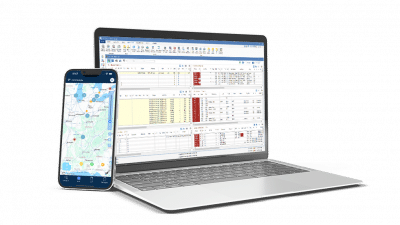
PCS Software builds dispatch automation with your Transportation Management System (TMS). Information flows automatically to billing, accounting, driver apps, and customer notifications.
Cortex AI is built into your TMS
Cortex AI runs inside your existing TMS. No new logins, no extra platforms. Your dispatchers keep using the same tools they already know.
Individual dispatchers now handle 35 to 40 trucks instead of the usual 15 to 20. The software handles the repetitive work in the background: pulling data, checking rates, tracking availability. Your team makes decisions instead of hunting through spreadsheets.
Cortex AI pulls freight data from load boards, customer emails, EDI transmissions, and uploaded documents. It ranks every opportunity by profitability, comparing lane history, current market rates, driver availability, and equipment positioning. Your dispatcher sees which loads make money before they quote anything.
The system works for carriers, brokers, and shippers running LTL, full truckload, intermodal, and over-the-road fleets. It scales with your operation, whether you’re running 10 trucks or 1,000.
Book a free demo to see how PCS automates route planning, handles real-time changes, and tracks capacity across your fleet.
FAQ
Route optimization finds the shortest path between stops based on distance and time. AI dispatch software adds predictive analytics on top. It learns how long your specific operations take, adjusts for traffic patterns in real time, assigns jobs based on driver skills and vehicle capabilities, and continuously rebalances work as conditions change throughout the day.
The system recalculates affected routes within seconds. You add a rush order at 2 PM, and AI dispatch software evaluates which driver can handle it with minimal disruption. The new assignment goes directly to the driver’s mobile device with updated routing. No phone calls, no manual rebuilding.
You get useful results immediately using industry defaults. Accuracy can improve within two to three weeks as actual performance data accumulates.
Your dispatchers review and approve AI-generated assignments before they go out. This catches obvious errors before drivers show up and can’t deliver.
PCS integrates AI dispatch directly into the TMS, so everything works together from day one. If you’re using a different TMS, integration depends on whether that system has APIs for automated data exchange. Standalone AI dispatch tools that don’t integrate create more problems than they solve because you’re manually transferring data back and forth.