Transcript
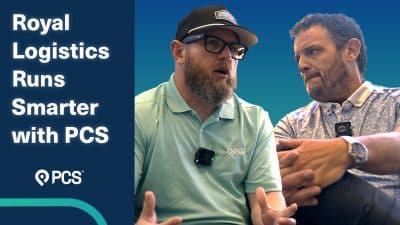
Hey everyone, Jason here with PCs and I’m with Caleb Gross from Royal Logistics. So Caleb, you were one of our beta testers for Cortex, which has these AI capabilities. AI came out in trucking, and it’s a buzzword that has often been a lot of fluff from many people. What’s your experience? What’s the non-fluff stuff that’s worked for you?
Truthfully, the amount of operational efficiencies it creates on the operations side of things—such as automation and the Backhaul Assistant—puts everything in one place. You don’t have an operations team going here to get this, there to get that; everything is centralized. When I worked for Chuck Boat, sometimes you could spend three hours looking for a load during the day because every time you call, it’s already booked. You keep calling and calling.
Backhaul Assist allows you to narrow down options and see the relationships you’ve built with whoever you haul loads for. Instead of sitting on hold trying to reach a random broker you don’t know, you can send a direct email to a contact. It really cuts down on time, and you’re not just searching random load boards. It also helps tremendously from a planning standpoint. For example, if you’re sending a truck to Knoxville next Friday, you immediately know what you’ve done out of there before without having to guess. It finds the most efficient option for you.
This helps grow stronger relationships because the operations team can guarantee more capacity. Dispatch can easily get lost in where trucks are sent and how often, but when you have that info in front of you, you start to see patterns—like talking to Joe about a load out of Knoxville five times in a week. That sparks conversations about how much freight Joe has out of Knoxville and opens other opportunities, like loads to Houston. It expands your core business.
We envision that if you go to Knoxville every Friday, Cortex can automatically look for that backhaul load, building relationships over time. In today’s trucking market, relationships are everything. It’s easy for someone to choose the cheapest carrier, but if you have a relationship and can commit capacity—and Cortex helps automate that—it’s a win-win. When customers recognize your name, they’ll choose you over an unknown bidder, especially since automation lets you plan ahead and know you’ll have five trucks in a certain area soon.
As far as streamlining processes, the biggest difference has been in the billing cycle and paperwork. Everything flows better, even if I can’t explain why. AI can seem scary, but Cortex runs in the background, making it less intimidating. PCs built Cortex to integrate seamlessly, so onboarding was really easy. I tell people all the time: if I don’t know how to do something in PCs, it’s because I’m trying too hard. PCs is one of those softwares where everything is easier than you expect because you’re used to taking ten steps for one task, and PCs combines that. Cortex takes it further by combining tasks into one button or phrase.
From the carrier side, natural language queries like “Where are my Walmart loads?” save time and put things into perspective. Operational efficiencies allow your team to focus on revenue-driving tasks instead of monotonous ones like tracking. The number one way PCs helps is by making operations more efficient and keeping everything in one spot—from fleet to accounting to dispatch. For an organization with 100 trucks and 240 trailers, that’s key. Ease of use is another major factor. Training new people is hard, especially with an aging workforce, so the simpler the system, the more efficient you are. Ease of use and having everything in one TMS are the two most important things.