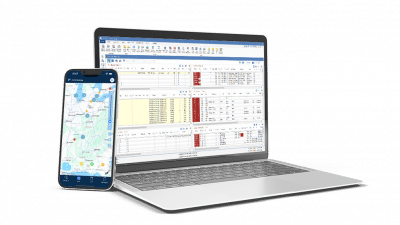
Carriers want to grow without growing staff at the same pace. As PCS CEO Mark Hill put it on the FreightCaviar podcast, “If they have 15 trucks, they want 30. If they have 30 trucks, they want 50.” His view is that AI is how the next stretch of growth gets done without adding back office at the same rate. PCS sees it in dispatch: one dispatcher has typically handled 20 to 30 trucks, and fleets using Dispatch powered by Cortex are seeing the potential to scale that to 35 to 40.
Use this as your getting-ready list. Each item is a point Hill made on the episode, turned into a next step.
☐ Get your dispatchers hands-on with AI tools now
Hill’s advice: learn Claude, ChatGPT, Grok, or whatever AI tool you like. Treat it as a partner, not a search box. Give it a real problem, like moving a truck from Chicago to Dallas as efficiently as possible, and work it together.
☐ Decide what agents take first, and what stays with your people
Hill expects dispatchers to spend less time on screens and more time working through their own agents over the next two to three years. Calls, emails, texts, and scheduling are the natural starting points. Keep negotiation with your people. He isn’t a fan of voice agents haggling over rates, because that’s where your special sauce lives.
Free Guide
Understand AI, Automation and Agents in Trucking: The Cost of Falling Behind.
☐ Write the rules before agents touch your system
An agent can copy itself a thousand times. You wouldn’t hand a stranger the keys and say “go dispatch my trucks.” You’d vet them and give them a handbook, and agents need the same: rules, security, and clear access. Hill’s view is that the TMS, as the system of record, is where that control belongs, and that’s the direction PCS is building toward.
☐ Don’t smooth your network
Hill agrees fragmentation is a feature, not a bug. Freight has to move everything from blow dryers to high-value electronics, so the network needs big, mid-size, and small carriers, specialists, and generalists. Think of a jar of rocks: leave out a size and it doesn’t fit. Smooth the network over and you lose efficiency. When you automate, keep your edge cases and solve for the customers, dispatchers, and drivers in the loop. In Hill’s words, the network “needs solving and it doesn’t need smoothing.”
☐ Plan for high diesel, and burn it on fewer empty miles
Hill compares running a trucking company without understanding diesel to running a fishing charter without checking the weather. He’s an energy veteran, and his read is that this is a supply and logistics problem, not a source problem. Refining capacity is tight and reserves are low, so relief at the pump won’t come fast. Diesel averaged $6.13 a gallon on Nov. 10, up $2.51 from a year ago, according to the EIA data he cites in his FleetOwner column. His advice: you can’t control the price, but you can control how many empty miles you burn it on. At the industry’s 16.5% deadhead rate, he puts empty miles at roughly $15,000 in fuel per truck per year. Start the backhaul search when the outbound load is booked, not when it delivers.
☐ Keep an eye on how carriers prove who they are
Hill says 99.9% of carriers are legit, yet every one gets interrogated. He wonders whether carriers could hold their own verified credential, like TSA PreCheck, and bring it to market. It’s an idea to watch, not something to act on yet.
Check them off, and your dispatchers spend less time on busywork and more time on the decisions that protect margin. That’s why PCS built Cortex from hundreds of customer conversations about what dispatchers don’t want to do every day.
See Dispatch powered by Cortex on your fleet. Our team will build a personalized demo around the use cases you care about most, so your dispatchers can move more loads with smarter tools. Request a demo